The Women’s Haftarah Commentary: New Insights from Women Rabbis on the 54 Weekly Haftarah Portions, the 5 Megillot & Special Shabbatot by Rabbi Elyse Goldstein
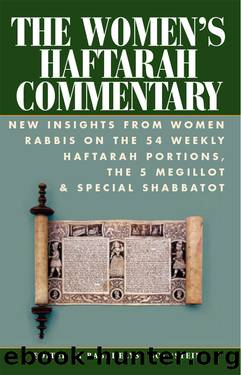
Author:Rabbi Elyse Goldstein
Language: eng
Format: epub
Tags: Judaism; Jewish women; Women rabbis; Haftarah; Jewish Prophets; Jewish Writings; Megillot; Jewish traditions; Jewish scripture; Feminist understanding of the Haftarah; Feminist understanding of the Five Megillot; Rabbi Elyse Goldstein
Publisher: Jewish Lights Publishing
Special Shabbatot
RABBI ILENE SCHNEIDER
Haftarat Shabbat Rosh Chodesh
Isaiah 66:1–24
For as the new heaven and the new earth
Which I will make
Shall survive by My will
—declares YHVH—
So shall your seed and your name continue.
And new moon after new moon,
And Shabbat after Shabbat,
All flesh shall come to worship Me
—said YHVH.
(ISAIAH 66:22–23)
TRY TO IMAGINE: a pitch-black night, with no light pollution to dim the stars. The Milky Way is a carpet of pinpoint bits of light. Low in the eastern sky is the merest sliver of a crescent moon, the same moon that two weeks earlier had been a glowing disk, bright enough to cast shadows; the same moon that had waned and disappeared, only to appear again, miraculously, as it did in its predictable four-week cycle.
Now, try to imagine how such a phenomenon must have seemed to our ancient ancestors, who had no inkling that the earth was not the center of the universe, or that the surface of the moon was as solid as the earth, or that we would someday walk on it and dream of living there.
The rotation of the moon around the earth, while not understood in the scientific terms we take for granted today, was well observed by ancient peoples. It was a constant in their lives, and a natural focal point for them to use to organize their lives, both ritual and mundane. Most calendars, from the Incan to the Celtic to the Babylonian, were predicated on the lunar cycle. Today, both the Jewish and Muslim religious calendars are still lunar-based. The importance of the new moon can be seen in the Muslim symbol of the crescent moon and in the monthly recitation of the Rosh Chodesh haftarah (Isa. 66:1–24) on the Shabbat before its expected appearance.
At first reading, there is little that Isaiah says that defines Rosh Chodesh as a day special to women. Indeed, there is little, until the end of the haftarah, that even connects his theme with Rosh Chodesh.
At the beginning of the haftarah, Isaiah rails against pride, hypocrisy, and insincerity. He decries those who believe that a humanbuilt Temple is greater than anything God could create:
YHVH said:
The heavens are My chair
And the earth is My footstool:
Where could you build a house for Me,
What place could serve as My dwelling?
My hand made all these things,
And so it all came into being
—declares YHVH.
(Isa. 66:1–2)
He continues with a screed against those who bring sacrifices but do not truly repent:
As for those who slaughter oxen like killing humans,
Who sacrifice sheep as though they were breaking a dog’s neck,
Who present the blood of swine as an offering,
Who offer incense but worship false gods—
Just as they have chosen how to act
And take pleasure in their sacrilege
So I will choose to taunt them,
To bring on them the very thing they fear.
For I called and no one replied,
I spoke and no one paid attention.
They did what I deem evil
And chose what I do not want.
(Isa. 66: 3–4)
The connection with Rosh Chodesh is made at the end of the haftarah, in a
Download
This site does not store any files on its server. We only index and link to content provided by other sites. Please contact the content providers to delete copyright contents if any and email us, we'll remove relevant links or contents immediately.
The Five People You Meet in Heaven by Mitch Albom(3645)
The Secret Power of Speaking God's Word by Joyce Meyer(3459)
Real Sex by Lauren F. Winner(3086)
Name Book, The: Over 10,000 Names--Their Meanings, Origins, and Spiritual Significance by Astoria Dorothy(3015)
The Holy Spirit by Billy Graham(3015)
0041152001443424520 .pdf by Unknown(2904)
How The Mind Works by Steven Pinker(2891)
ESV Study Bible by Crossway(2820)
Ancient Worlds by Michael Scott(2739)
Churchill by Paul Johnson(2666)
The Meaning of the Library by unknow(2640)
The ESV Study Bible by Crossway Bibles(2586)
The Gnostic Gospels by Pagels Elaine(2574)
MOSES THE EGYPTIAN by Jan Assmann(2464)
Jesus by Paul Johnson(2423)
City of Stairs by Robert Jackson Bennett(2409)
The Complete Dead Sea Scrolls in English (7th Edition) (Penguin Classics) by Geza Vermes(2321)
The Nativity by Geza Vermes(2258)
Ancient Near Eastern Thought and the Old Testament by John H. Walton(2247)
